


For decades, gold found its way into investor portfolios as a safe haven. Any time there was economic uncertainty or geopolitical tension, gold prices would jump. The first six months of 2026 changed all assumptions related to the yellow metal. The US-Iran conflict sent gold prices sharply lower. By the end of June, gold was trading at seven-month lows.
With correlations being broken and then establishing in the opposite direction, how do traders decide whether to buy or sell? How do they respond to a news event or a data release? This is where gold signals come in, telling you when to enter and exit the market.
What are Gold Signals?
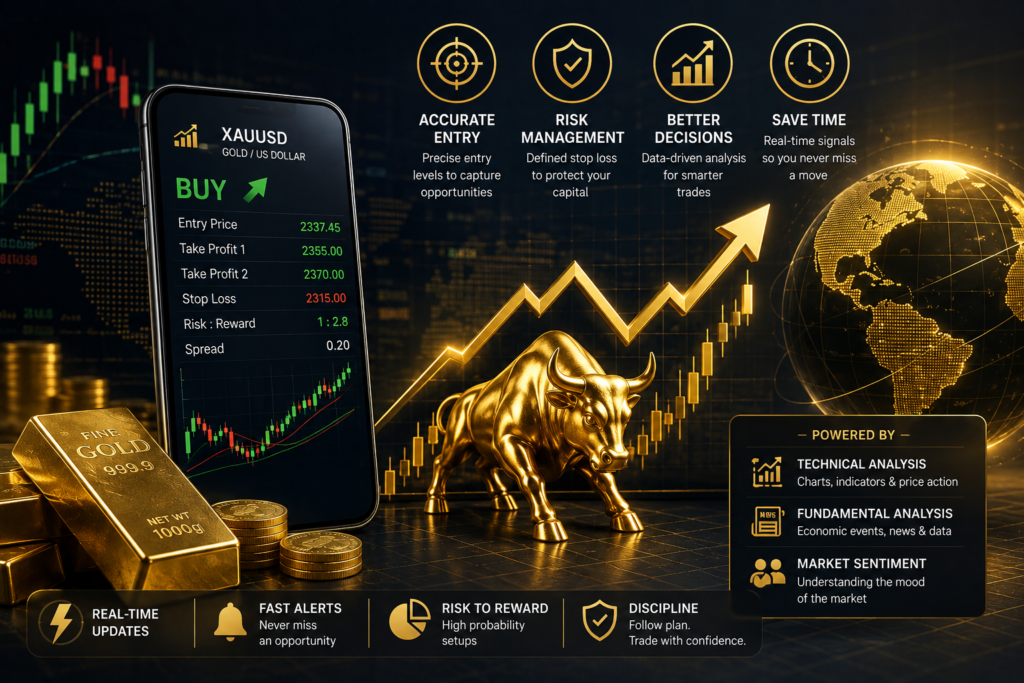
Gold trading signals are actionable trade ideas based on technical analysis, market trends and price action. They give you a lot of useful information in a snapshot, so you don’t need to spend hours staring at charts. Used correctly, they can help you make faster, more informed decisions. Most importantly, they help you avoid emotional trading.
A typical signal includes:
- Direction in which to trade – to buy or go short
- Entry price – when to enter a trade
- Exit points – one or more take-profit targets
- Stop-loss – so you don’t miss out on risk management
The goal is simple. It is to help traders capture market opportunities, even those who don’t have the time or knowledge to analyse charts.
Why Gold Traders Use Signals
What moves gold? Economic data, central bank purchases and interest rate decisions, and geopolitical events can cause prices to fluctuate. Inflation in the US and movements in the greenback also have a major impact on gold because prices in the global markets are quoted against the USD.
In 2025, gold rose to record highs more than 50 times on geopolitical tensions. The trend reversed in 2026, when the yellow metal fell as geopolitical conflict intensified. For CFD traders, these moves present many opportunities. But timing is critical. Gold signals help you spot these opportunities and manage risk. They help you base your trading decisions on purely analysis, rather than on emotions.
How Gold Signals are Created
Trusted signal providers combine different types of market analysis to generate signals.
Technical Analysis
This forms the foundation of most gold signals. Analysts study support and resistance levels, trendlines, moving averages, Relative Strength Index (RSI), Moving Average Convergence Divergence (MACD), Fibonacci retracements and candlestick patterns.
If multiple indicators point in the same direction, confidence in the trade usually increases.
Fundamental Analysis
Technical charts alone are not enough for gold. Professional analysts also monitor important economic data, such as US inflation reports, Federal Reserve interest rate decisions, the US Dollar Index (DXY), Treasury yields, employment data, central bank gold purchases worldwide and geopolitical developments.
For example, expectations surrounding changes in US interest rates and the ongoing US-Iran war continued to drive major swings in gold prices throughout 2026.
Market Sentiment
Experienced traders also watch how investors are positioned. If fear rises across financial markets, gold often attracts safe-haven demand. Likewise, improving economic confidence may reduce buying interest.
Understanding sentiment helps explain why prices sometimes move even when technical indicators appear neutral.
How to Use Gold Signals Effectively
Receiving a signal is only the first step. You must know how to use it properly to effectively capture trading opportunities.
Check Market Context
Before opening a trade, spend a minute looking at the overall trend. Ask yourself: Is gold trending higher or lower? Are major economic announcements scheduled today? Is volatility unusually high?
Trading with the broader trend generally improves the probability of success.
Follow Risk Management
Never risk too much on a single trade. Many experienced traders limit risk to 1% or 2% of their trading capital per position. Also, they always use the suggested stop-loss. Moving or removing a stop-loss after entering a trade can turn a small loss into a much larger one.
Avoid Overtrading
Not every signal needs to be traded. If several positions are already open or market conditions look unusually unstable, skipping a trade can be the smarter decision. Discipline often matters more than finding additional opportunities.
Understand Why the Signal Was Generated
A top-rated service that offers free gold trading signals or at competitive pricing will explain their reasoning. Reading the accompanying analysis can help you improve your own skills over time instead of blindly copying trades. With this, many traders begin recognising similar setups independently over time.
How to Choose the Right Gold Signal Service
Not all signal providers offer the same quality. Look for services that provide:
- Real-time market price
- Entry and exit levels
- Risk-reward ratio of that trade
- Spread at entry
- Fast updates when market conditions change
Avoid services that promise guaranteed profits. No trading strategy wins every single time. Look at TrustPilot reviews before choosing your provider. Check what previous traders have said about their customer support.
Final Thoughts
Gold is one of the most dynamic trading markets. Recent market moves show just how important timely analysis has become. For CFD traders, reliable gold signals can simplify decision-making, improve discipline and support better risk management. These signals can become a valuable part of a well-planned trading strategy. But remember to also do your own research.
Make informed gold trading decisions with real-time signals and market analysis from a top-rated gold trading signal service. Sign up today.
Risk Warning: Educational purposes only. No investment or financial advice. Trading CFDs involves significant risk. Please refer to the full disclaimer available on our website.